The report "From Digitalisation to AI Empowerment – The Future of Higher Education in the Global South" (hereinafter the "Report") was officially launched at the Global Future Higher Education Summit on 6 June 2026. The report offers a reference for Global South countries in formulating digital transformation policies and advancing implementation at the institutional level, helping the digital and AI-empowered transformation of higher education develop in a more equitable, practical, and sustainable direction.
The report "From Digitalisation to AI Empowerment – The Future of Higher Education in the Global South" is a comprehensive research outcome of the International Centre for Higher Education Innovation under the auspices of UNESCO (UNESCO-ICHEI), drawing on insights from around the world and systematically reviewing the common challenges in the digital transformation of higher education across the Global South.
Since 2023, UNESCO-ICHEI, together with UNESCO field offices, UNESCO Category 1 Institutes, international and regional organisations, research institutes, and experts from higher education institutions and relevant organisations, has conducted a series of joint research on the current status, challenges, and future of digitalisation and AI transformation in higher education across multiple regions and sub-regions of the Global South, including Africa, Southeast Asia, South Asia, Central Asia, East Asia, the Arab region, and Latin America and the Caribbean.
Drawing on the findings of seven regional and sub-regional studies, this report focuses on two perspectives: the digital competency of the higher education workforce and the institutional digital support capacity. It analyses variations in digitalisation practices, practical challenges, and feasible pathways across regions and institutions in the Global South.
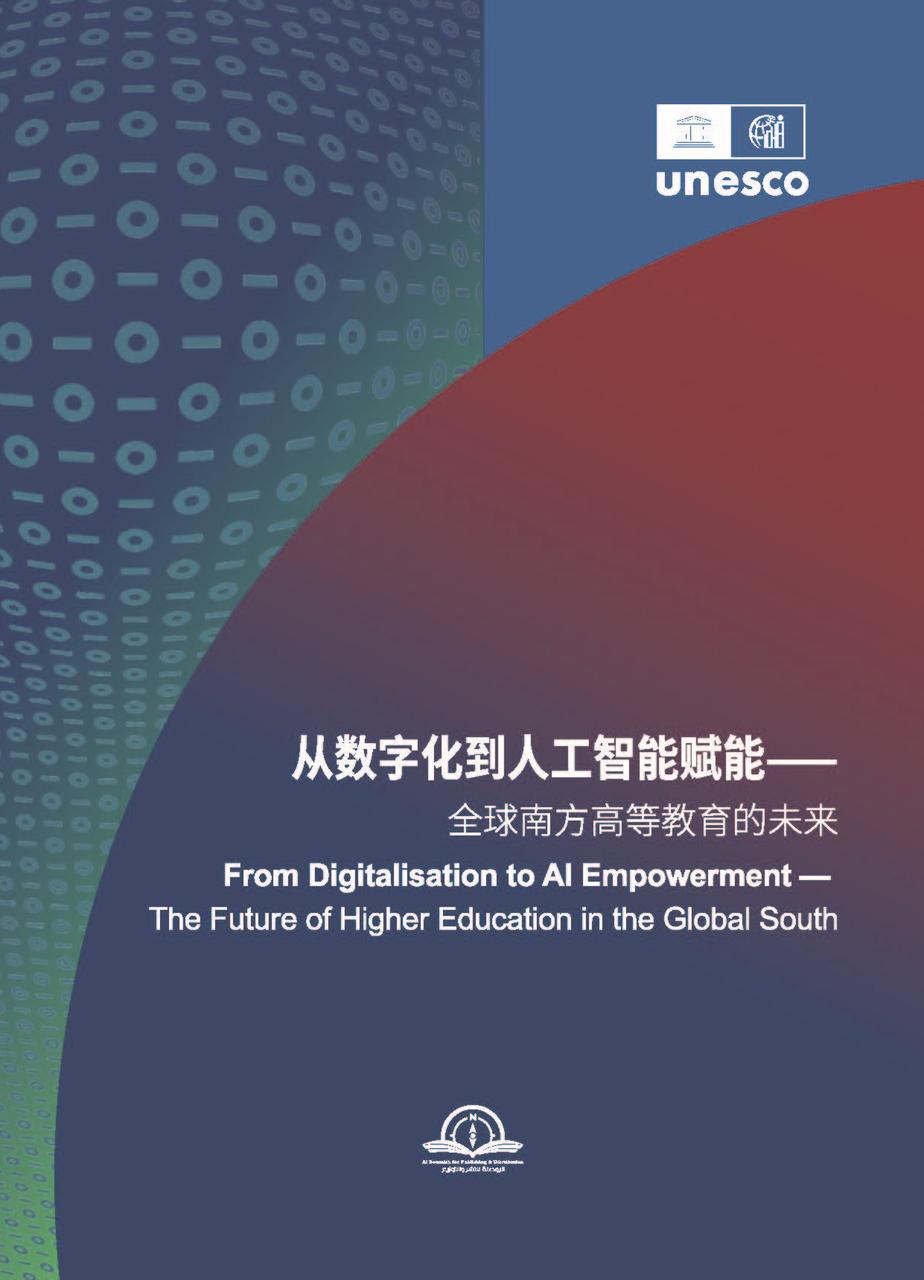
From Digitalisation to AI Empowerment – The Future of Higher Education in the Global South
Report Structure
The Report is organised into five parts, unfolding along a logical progression of "context — global trends — models of digital and AI empowerment — challenges — responses." Part I, the Introduction, sets out the background, purpose, and scope of the study. Part II provides an overview of the evolving trend of higher education toward AI empowerment and outlines the analytical perspectives of this report. Part III approaches the issue from two perspectives, namely digital competency of the higher education workforce and institutional digital support capacity, and presents institutional case studies. Part IV analyses the key challenges constraining the transformation process. Part V proposes strategic priority actions.
Research Methodology
This report adopts case-based empirical analysis as its research methodology. Through the analysis, synthesis, and assessment of practical cases from representative countries and higher education institutions featured in the seven regional and sub-regional reports, it presents a holistic study grounded in individual cases and identifies common characteristics, regional differences, and transformation pathways. The report ultimately presents a comprehensive synthesis study intended to provide an important reference for strategic planning, policymaking, and practical cooperation in the digital transformation of higher education in the Global South. The seven regional and sub-regional reports were based on extensive research and case analyses, with a sample covering 67 countries, over 500 higher education institutions, more than 40 organisations and enterprises, and 28 case studies across the regions of the Global South.
Key Findings
The study finds that progress in digitalisation across the Global South remains uneven: while some countries have achieved large-scale advancement through top-level design and unified platforms, many other countries and institutions still face practical challenges such as inadequate infrastructure, limited capacity, and inefficient mechanisms, resulting in differentiated transformation pathways and implementation outcomes.
Overall, the digital and AI transformation of higher education across the Global South is progressing from foundational digitalisation toward AI applications, although significant disparities remain in the pace and depth of regional progress. Development pathways are diverse and directly influenced by the digital competencies of the workforce and the institutional support conditions. A widespread disconnect persists between policy requirements and classroom practice, constraining the depth and effectiveness of transformation efforts. The digital skills of the workforce vary considerably, sustained training remains insufficient, and capacities for the pedagogical application of AI are generally limited. At the institutional level, inadequate coordination and insufficient support make it difficult for high-quality practices to be replicated, scaled up, and sustained over the long term. In this context, multilateral cooperation, joint platform development, and regional collaboration have become key means of addressing shortcomings and expanding impact.
Priority Directions for Actions
In response to the challenges identified above, this report proposes six practical directions for action: providing higher education workforce with regular and sustainable professional development support centred on digital competencies; incorporating innovation in digital teaching into faculty incentive and promotion systems to enhance motivation for participation; respecting the realities of frontline teaching by carrying out localised and implementable capacity building with teachers as the main actors; improving institutional governance and coordination mechanisms to enhance the planning and implementation capacity of digital transformation; accelerating efforts to address shortcomings in connectivity, equipment, and platforms and to build mutually beneficial and usable digital conditions; and promoting multi-stakeholder coordination and practical cooperation between education and industry to develop multi-level and sustainable digital support capacities.
These six directions target both the higher education workforce and the institutional support system, whose coordinated advancement is essential to deepening and consolidating the digital transformation of higher education. The report emphasises that multilateral cooperation, joint platform development, and regional collaboration are key means of addressing shortcomings and expanding impact, offering a practical pathway for the Global South to achieve resource sharing and mutual support through South–South cooperation.
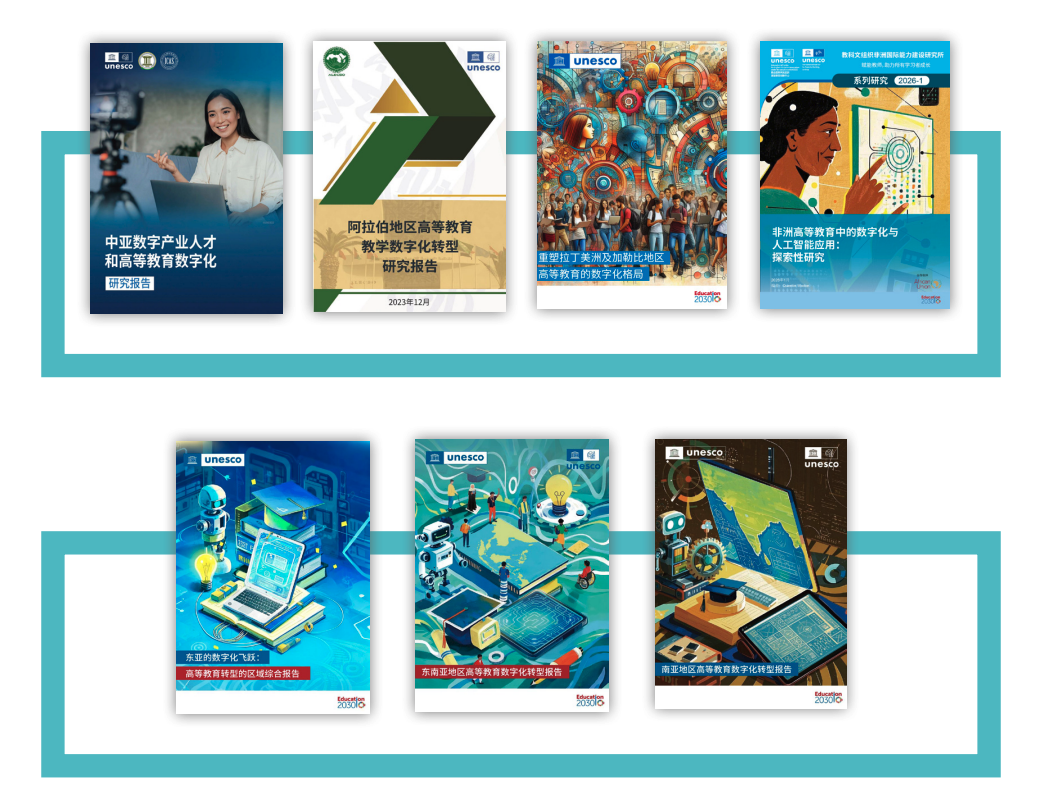
Seven regional and sub-regional reports
As a contributor to UNESCO's Education 2030 Framework for Action, UNESCO-ICHEI will always uphold a human-centred, inclusive and equitable development philosophy. Through high-quality capacity development and practical cooperation, it will continue to advance the digital and AI-empowered transformation of higher education in the Global South, and contribute to the achievement of equitable and quality education and the Sustainable Development Goals.
To read more about the report
"From Digitalisation to AI Empowerment – The Future of Higher Education in the Global South," please
click here or click "
Read the Original" to download the full report. To learn more about region-specific practices, typical cases, and differentiated transformation pathways, you are welcome to
click here to consult the full texts of the seven regional and sub-regional research reports on which this report is based.